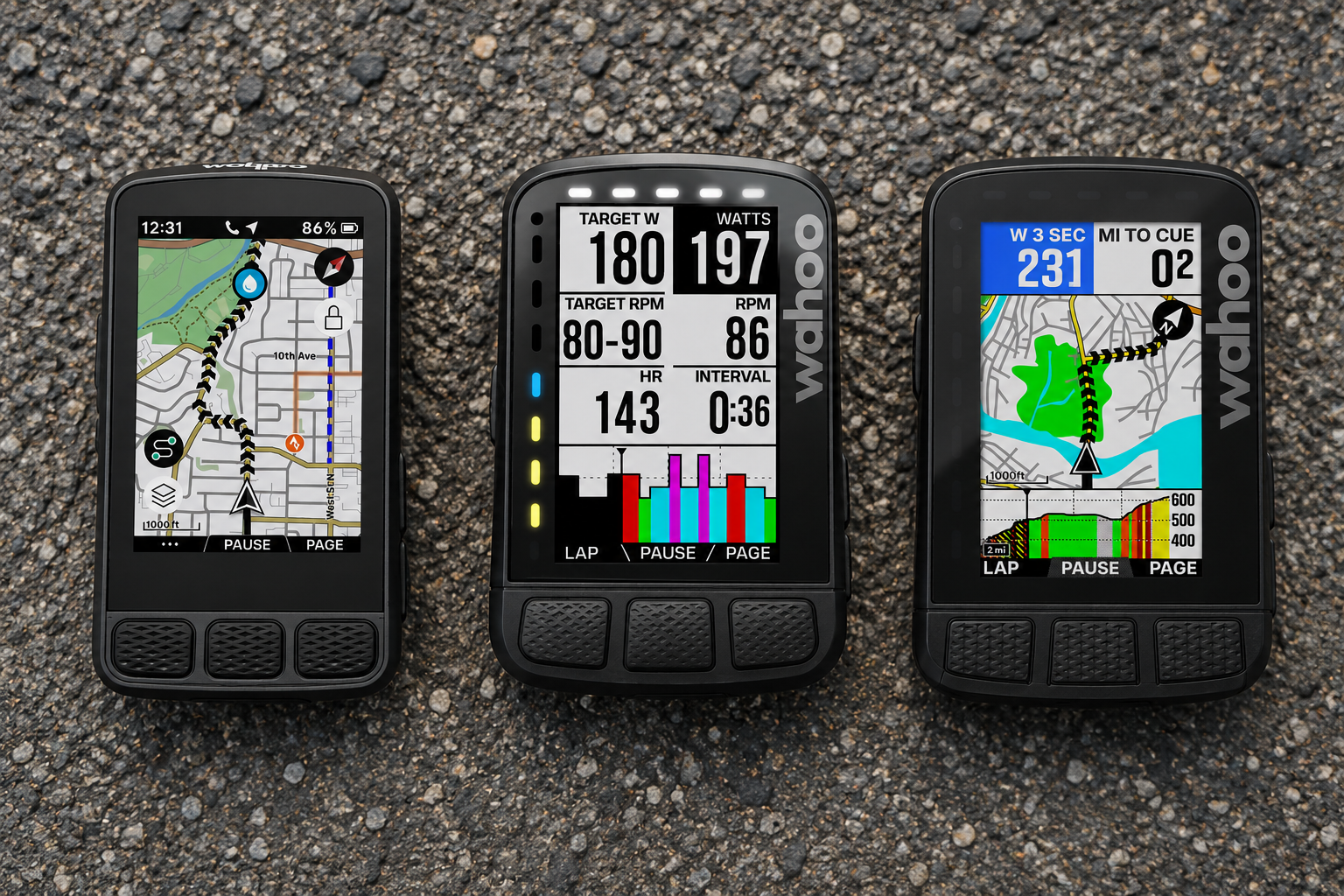
Every time Wahoo drops a new version of the ELEMNT ROAM, the cycling forums light up with the same question: is it actually worth upgrading? I've been a Wahoo rider since 2018 — BOLT first, then a brief and regrettable detour through Garmin territory, then the ROAM v1, then v2, and now staring down the v3. That's a lot of bike computers for one person to have opinions about. But here we are. Let me break down what actually changed across all three generations, what I noticed in the real world versus what looks good on a spec sheet, and whether making the jump makes sense for you.
Jump To
A Quick ROAM Origin Story
My relationship with Wahoo goes back to 2018, when I picked up an ELEMNT BOLT as my first dedicated bike computer. I've written about that whole journey in an earlier post, but the short version is: the BOLT spoiled me. It was slow to boot, not the slickest device on the market, and certainly no match for a Garmin on paper — but it was rock solid reliable, and that ended up mattering more than any spec sheet.
Which is exactly why I made what turned out to be a mistake: I traded it for a Garmin Edge 830.
The Garmin looked great on paper. Better mapping, more features, slicker interface. And for a while, it was fine. Then came a 57-mile ride on a hot Texas summer day when my heart rate monitor started dropping out — and didn't stop. For the second half of the ride, in the worst heat of the day, I had no idea what my heart rate was doing. Was I overexerting myself? Was I about to blow a gasket? No clue. All those fancy Garmin features meant exactly nothing in that moment. (I wrote about the full experience here if you want the gory details.)
I boxed it up and exchanged it for a Wahoo ELEMNT ROAM within three months.
The ROAM v1 — released in 2019 — was a big deal for Wahoo at the time. It was the first Wahoo bike computer with a color screen, better on-device navigation (Back on Track, Route to Start, rerouting without reaching for your phone), and Gorilla Glass for durability on rougher terrain. Not a full color screen mind you, more like a "we're going to sprinkle color in where it matters" situation. But compared to the BOLT, it felt like a proper grown-up device.
So when v2 landed in 2022, and then v3 followed in 2025, each new generation had a lot to live up to.
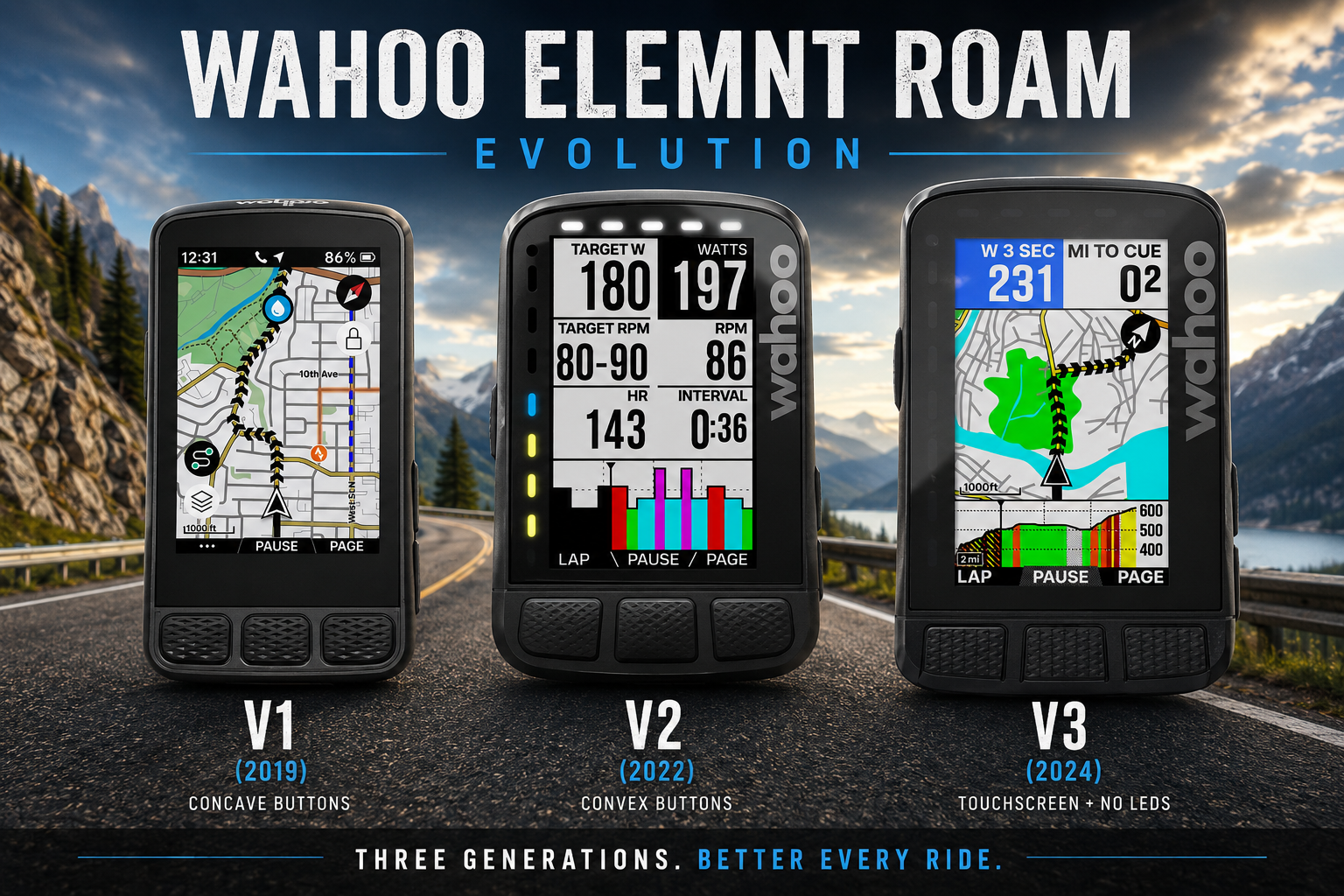
The Version-by-Version Breakdown
Here's how the three generations stack up across the specs that actually matter for everyday riding:
Feature | ROAM v1 (2019) | ROAM v2 (2022) | ROAM v3 (2025) |
|---|---|---|---|
Screen Size | 2.7" | 2.7" | 2.8" |
Screen Colors | 8 colors | 64 colors | 16 million colors |
Touchscreen | No | No | Yes (+ buttons retained) |
GPS | Single-band GNSS | Dual-band GNSS | Multi-band GNSS (L1 + L5) |
Battery Life | Up to 17 hrs | Up to 17 hrs | Up to 25 hrs |
Storage | 4 GB | 32 GB | 32 GB |
Charging | Micro-USB | USB-C | USB-C |
Buttons | Concave (recessed) | Convex (raised) | Convex (raised) |
LED Indicators | Yes (top + sides) | Yes (top + sides) | Removed |
Audio Turn-by-Turn | No | No | Yes |
App | ELEMNT Companion | ELEMNT Companion | Wahoo App |
V1 to V2: The "Nice But Is It Worth It?" Upgrade
Here's the honest truth about the v1 to v2 jump: it felt incremental. Like, genuinely incremental.
The screen went from 8 colors to 64 colors, which sounds dramatic until you realize neither version is what you'd call a full-color display. But in practice? The v2 display does look noticeably fresher and more polished. The map is cleaner and easier to read. Whether that's worth the price of a new device is a different question.
The GPS got bumped from single-band to dual-band, which in theory means better accuracy — especially in tricky environments like dense tree cover or urban canyons. In reality, for everyday road and gravel riding in open-ish terrain, both units work just fine. I honestly couldn't tell a meaningful difference in my rides.
Battery life stayed the same at 17 hours. Which is... fine? I've never had the v1 die on me mid-ride, so I wasn't exactly crying out for more juice there.
The two changes that actually made me go "okay, that's an improvement":
The buttons. The v1 had concave (recessed) buttons that were perfectly functional under normal conditions but could be a little fiddly with gloves on or in the rain. The v2 flipped to convex (raised) buttons — a small change that makes a real ergonomic difference when your hands are cold and wet and you just want to scroll to the next data page without a wrestling match.
USB-C charging. Finally. Micro-USB was already feeling dated in 2022, and ditching it for USB-C means one less proprietary cable to hunt for in your gear bag.
Storage jumped from 4 GB to 32 GB, which matters more than you might think. More onboard storage means more detailed maps pre-loaded and less fiddling around with what to download before a trip.
So: v1 to v2 felt like a solid polish rather than a revolution. If you were happy on v1, you wouldn't have felt left behind. If your v1 had a cracked screen or you were in the market for a new unit, the v2 was the obvious call.
My Personal Take on the V1 → V2 Jump
Honestly? I think if I had still been on a v1 when the v3 came out, I would have skipped the v2 entirely and jumped straight to v3. The generational leap would have felt much more satisfying. Going from v1 to v2 felt less like an upgrade and more like a tune-up.
V2 to V3: Now We're Talking
The v3 is where things get genuinely interesting.
The display. Going from 64 colors to 16 million colors is not a subtle change. The v3 screen is a legitimate full-color display — maps look rich, data pops, and the overall experience is noticeably more premium. The screen also grew slightly (2.7" to 2.8"), made possible by Wahoo removing the LED indicator strips to reclaim that real estate.
Speaking of which — the LED indicators are gone. I know some people loved those. Personally, I found them mostly decorative (especially on bright days when you basically couldn't see them), so I'm not mourning their loss. But if you used them for workout targets, that's worth knowing going in.
Touchscreen. This is probably the headline feature of the v3. You can finally pinch, zoom, and swipe your way around the map — while still keeping the physical buttons for wet and gloved riding. Having both is the right call.
Battery life jumped to 25 hours, up from 17. That's a meaningful improvement, not just a spec sheet number. For longer gravel days, bikepacking, or just riders who charge infrequently, that extra range is genuinely useful. For me, 17 hours was already more than enough for any single ride — but the buffer means I'm even less likely to need to top up between back-to-back days out.
Multi-band GPS (L1 + L5) is the most technical upgrade and also the one most everyday riders will notice the least. Unless you're regularly navigating through dense forests or city canyons, dual-band was already doing the job. For adventure cyclists and bikepackers in legitimately challenging terrain, this is a real improvement.
Audio turn-by-turn navigation is a welcome addition that was previously only available on the higher-end ELEMNT Ace. No more squinting at the screen to catch a turn — your earbuds handle it.
So, Should You Upgrade?
Here's the thing about Wahoo users: most of us aren't here for the most cutting-edge feature set. We're here because these things work, and once you've had a device fail you on an important ride — and yes, I'm still talking about that 57-mile death march with a Garmin — reliability stops being a nice-to-have and becomes the whole ballgame.
With that framing in mind:
If you're on a v1: The v3 is a genuinely exciting upgrade. You'll feel every improvement — the display, the touchscreen, the battery, the GPS. This is the generational leap that makes you go "oh wow." Skip the v2 and go straight to v3.
If you're on a v2: The case is murkier. The touchscreen and full-color display are legitimately better. The battery bump is real. But if your v2 is working flawlessly and you don't have a specific pain point it's failing to address, that's exactly the kind of device you don't mess with. The best bike computer is the one you can count on.
If you're buying new: Get the v3. It's the most complete version of the ROAM yet, and the improvements over v2 are substantial enough that the price premium makes sense.
Me personally? I'm actually leaning toward making the jump — but probably not for the reasons you'd expect.
It's not that the v3 features are blowing me away. The touchscreen is nice. The full-color display is genuinely better. Twenty-five hours of battery is a real improvement. But none of those things represent a glaring hole in my v2 experience that I'm desperately trying to fill. My v2 works great. Every ride.
Here's the real reason I'm considering it: I write about bikes because I love it. And part of what makes that fun is actually having hands-on experience with the gear I'm talking about. There's a point at which staying on older equipment just to avoid the hassle means I'm writing about things I haven't actually lived with. If the v3 is where the ROAM is headed — and it clearly is — I'd rather be riding it than speculating about it.
The Wahoo App Question
One thing that's giving me legitimate pause, though, is the app transition. The ROAM v3 no longer works with the ELEMNT Companion app I've been using for years. It requires the new Wahoo app, which now manages the entire Wahoo ecosystem — head units, heart rate monitors, smart trainers, all of it — under one roof.
In theory, that sounds great. In practice? The reviews are... mixed. Some early adopters have praised the unified experience. Others have been less kind, calling it a step backward compared to what the ELEMNT Companion app was doing. There are also reports of people accidentally downloading the old ELEMNT app to set up their new Roam v3, which predictably went nowhere. (Classic.)
The deeper questions I have:
Will all my third-party service integrations — Strava, TrainingPeaks, etc. — carry over cleanly?
Does the new app have feature parity with everything I'm used to in ELEMNT Companion?
How different does the day-to-day setup and configuration experience actually feel?
Honestly, I don't know yet. And that's kind of the point. These are exactly the questions I'd want answered before recommending anyone else make the switch. Which means I probably need to just pull the trigger and find out for myself.
Stay tuned. There's a first-impressions post coming if I do.
Keep calm and pedal on!